Finder
The Finder (Ctrl+F) allows you to create dynamic Tables by querying for glyphs.
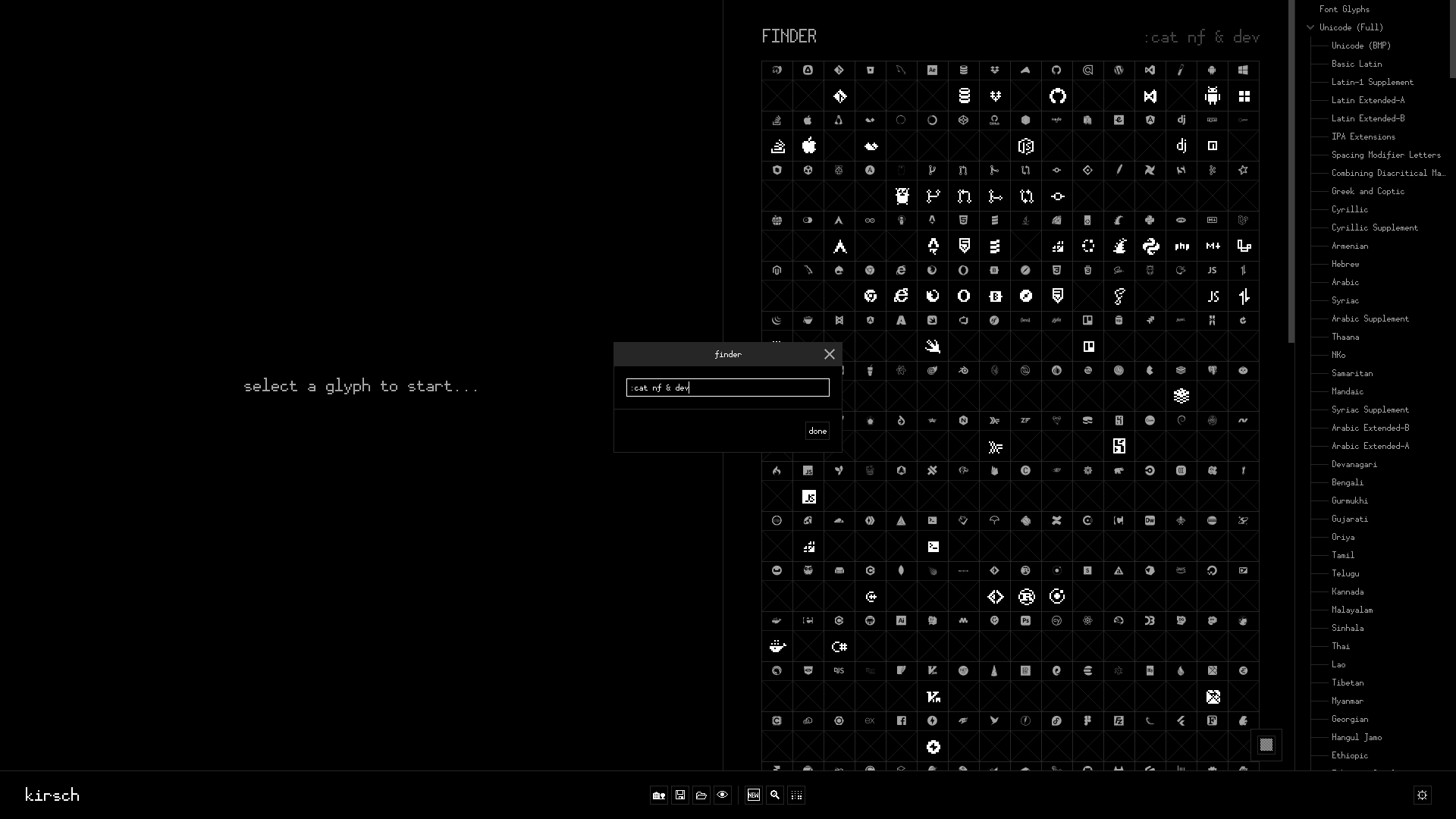
This is especially useful if, for example, you're looking for all instances of
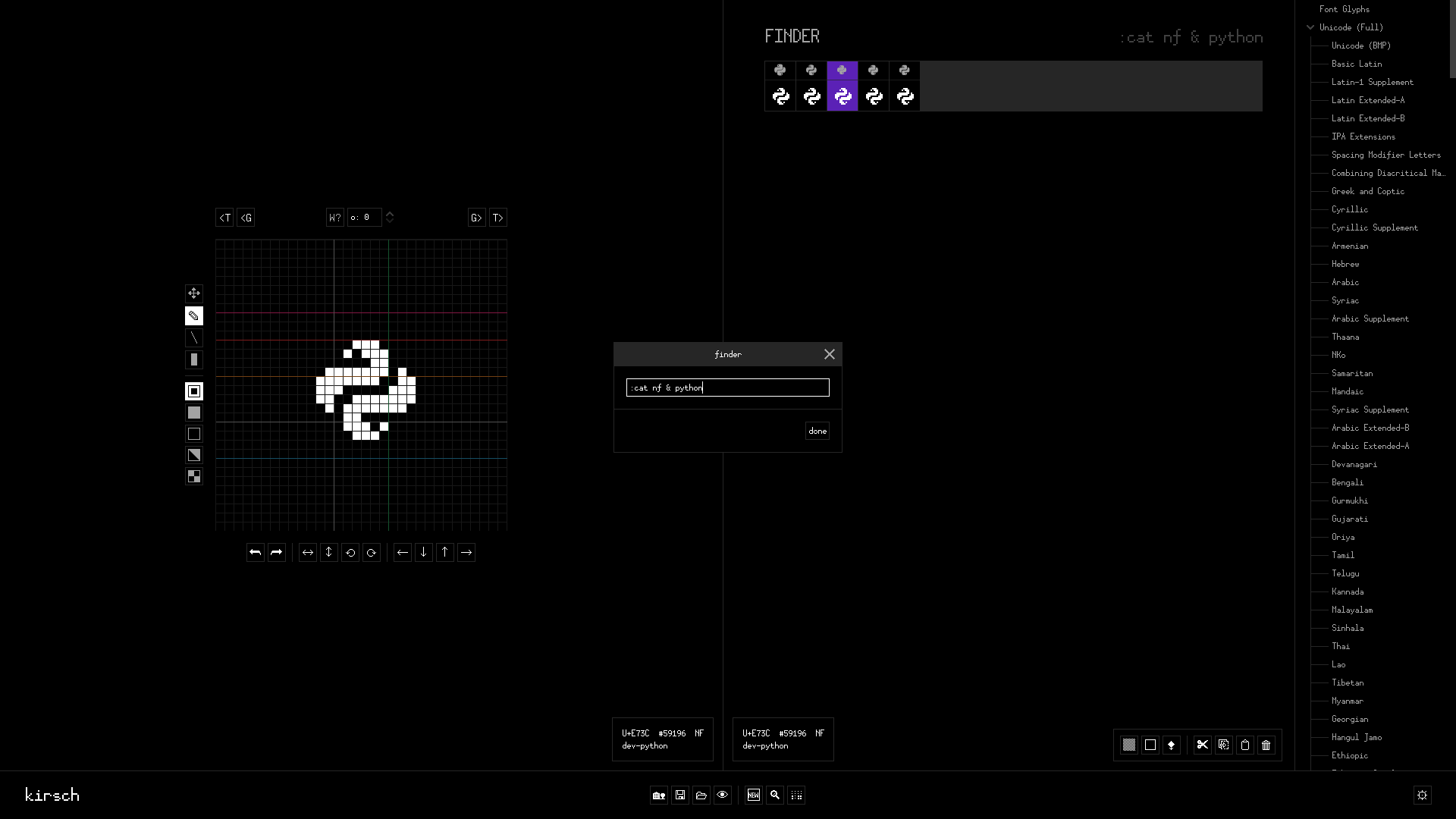
the Python logo in Nerd Fonts. You can type in a query like :cat nf & python,
then copy your design across all the matched glyphs.
Query Language
Warning
The query language is experimental (a.k.a. scuffed and subject to change).
The Finder has a rudimentary query language that internally transpiles to a SQLite statement.
Phrases
% _ Wildcards
%matches zero or more of any character._matches one of any character.
You can escape these with \, which treats them as normal characters.
Phrases are one of the query language's search primitives. If a word in the query isn't a special keyword, then it's a phrase.
The transpiler joins consecutive phrases with OR, so the query just some words
will return the combined results of just, some, and words.
Strings
In addition to phrases, the query language also features strings, denoted by
wrapping with ". This is useful if you want to search using a term that would
otherwise get broken up by the transpiler. The transpiler treats the contents of
strings as one phrase; strings and phrases are interchangeable.
You can escape " and \ inside strings with \.
; and SQL-Like
By default, the transpiler wraps phrases and strings with % -- i.e.
column LIKE '%<phrase>%' ESCAPE '\' in SQLite. But there are also keywords
followed by ; that won't wrap their subsequent phrases/strings. For example,
test and :; %test% are equivalent queries.
:cat
Filters any matching Unicode character categories. Has a SQL-LIKE variant.
bited has a character category NF for Nerd Font characters. This isn't an
official Unicode category, but is nevertheless included for easy querying of
Nerd Fonts.
Example: :cat cc
:block
Filters any matching Unicode blocks. Has a SQL-LIKE variant.
Example: :cat latin
:page
Filters any matching bited codepages. Has a SQL-LIKE variant.
Example: :page dyalog
:u
Filters any characters that match the specified hex codepoint or range of hex
codepoints. Individual hex codepoints can have % _ wildcards. Codepoint
ranges follow the format <hex>-<hex>, where <hex> is a valid hex number.
Example: :u 00A_, :u a0-ffff
& | !
Logical AND, OR, and NOT, respectively.
By default, the transpiler will join consecutive queries with AND -- e.g.
:block some words :page other words and
:block some words & :page other words are equivalent queries. Explicitly
including & becomes necessary when you want to join a keyword sequence with a
separate phrase, like in :block some words & a separate phrase.
( )
By default, AND takes higher precedence than OR -- e.g. a & b | c & d is
equivalent to (a & b) | c & d. For more fine-grained control over this
precedence, you can wrap queries with ( ), like a & (b | c) & d.
The transpiler is also nice enough to let you unbalance your parentheses. If you
write a | b) & c & (d, the transpiler will process it as (a | b) & c & (d).