Prototyping 2
Last week, I focused on drafting up motion designs to generate from/react to motion designs. This week, I instead focused on conceptualizing/visualizing the installation space to accompany the EEG headband.
Concept
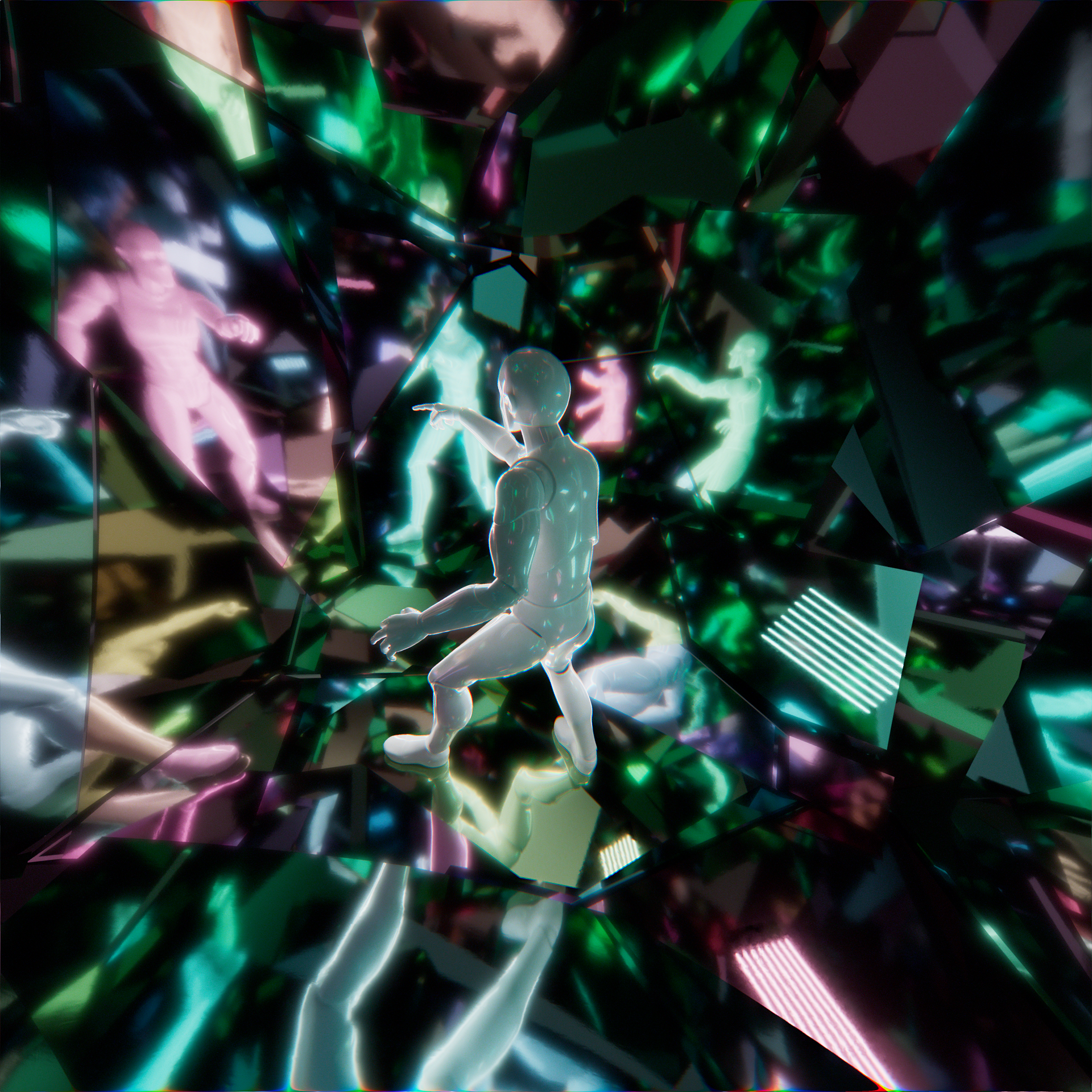
I wonder whether a “mirror maze” type of room would somehow affect brain activity by evoking confusion or concentration. Using 3D visualization, I played around with reflections and discovered several properties/techniques that could be used to help make the installation more “trippy.” These techniques include:
- Facing mirrors opposite one another for an “infinite subject” effect.
- Angling sets of mirrors such that each mirror reflects onto another but not vice versa. This allows for multiple mirrors to show drastically different angles/perspectives.
- Facing lights towards walls rather than towards the center/subject. Having the light bounce off of the reflections creates interesting visual effects, somewhat similar to generative art.
- Tinting/cracking/warping mirrors for visual distortion.
The goals with this mirror effect are to evoke a bit of a surreal/trippy/out-of-body experience. In combination with the previously-explored motions, the mirrors could further amplify the visual feedback received by the user. The process would go something like:
- Headband reads user’s brain activity, sending it to the laptop’s serial port.
- Software processes the brain activity and converts it into a visual representation/generation/artwork.
- Visuals are projected onto the set of mirrors and distorted/warped to create surreal/trippy physical effects.
- User sees visuals from mirrors, altering brain activity.
- Repeat/loop interactively in response to changes in brain activity.
My main issue with this idea is that it would be prohibitively expensive; cursory research has yielded that each mirror could potentially cost upwards of $100. Nevertheless, the idea has potential if I can find a way to reduce material costs. One alternative would be to use reflective paints, which does not provide the same visual clarity/reflectivity as a mirror but is significantly cheaper. Another possibility would be foil, which likely wouldn’t look good at all but has some reflectivity; with enough effort, it might be possible to create sheets of smooth foil that effectively act like mirrors. Worst-case scenario would simply be to drop the idea entirely and find another way to create physical distortions.